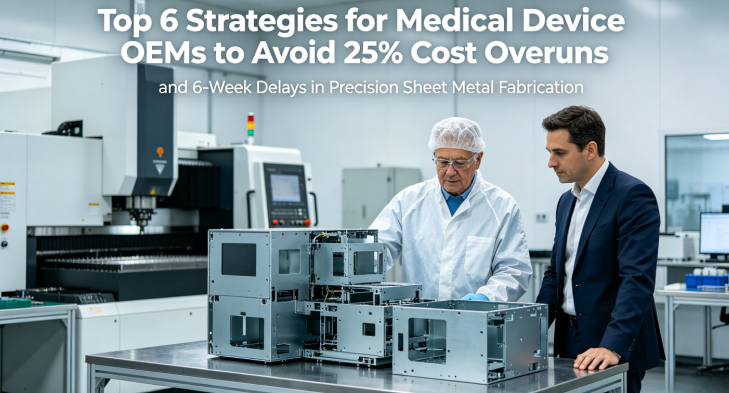
Top 6 Strategies for Medical Device OEMs to Avoid 25% Cost Overuns and 6-Week Delays in Precision Sheet Metal Fabrication
Introduction
Transforming an innovative medical device design into a high-volume product is tough. While prototypes might work great, scaling up can bring big problems like assembly snags, tolerance issues, and warping from welding. These hitches lead to plant shutdowns, ballooning costs by over 25%, and pushing project deadlines out by six weeks or more. Time-to-market suffers along with regulatory certification schedules.
This crisis often arises from a rift between design concepts and what’s feasible to manufacture. It gets worse when suppliers don’t have the thorough engineering expertise and process controls needed for complex medical parts. To fix this, the following strategies focus on minimizing risks throughout production. Starting from design tweaks to smart supplier choices, these tactics keep manufacturing know-how and sturdy quality checks front and center from start to finish, ensuring a smoother shift into large-scale production.
How Can Early Design for Manufacturing (DFM) Review Prevent Costly Rework in Medical Device Assembly?
An early, rigorous Design for Manufacturing (DFM) review is key. It stops pricey, time-consuming fixes later on. This process turns theory into actual manufacturable products. By finding problems like impossible designs, tolerance issues, and overcomplicated parts early, changes happen before any metal gets cut. This proactive look is vital for making medical devices efficiently. It also defends against blowing the budget and taking too long, making it super important right from the start.
1. Simulating Assembly and Optimizing the Build Sequence
A deep Design for Manufacturing (DFM) process isn’t just about checking individual part drawings. It includes virtual assembly simulation to spot issues that don’t show up until parts are put together. For something complex like a device housing, you need to analyze the bend sequence of multi-flanged parts to make sure there’ll be no tooling collisions. You also have to do a meticulous tolerance stack-up analysis to ensure the assembled product fits and functions correctly. This prevents expensive failures on the production line.
2. The Critical Language of Precision: Geometric Dimensioning and Tolerancing (GD&T)
Communicating design intent effectively is super important. Using the standardized language of Geometric Dimensioning and Tolerancing (GD&T) as laid out by the ASME Y14.5 guideline gets rid of confusion. It describes the size, shape, position, and location of parts precisely. This clarity means parts aren’t just printed right – they fit perfectly in their assemblies. This is crucial for stuff like safety-critical healthcare equipment, where precision can literally mean the difference between life and death.
3. Beyond Automated Quotes: The Value of Engineer-Led DFM
Online platforms may give you quick quotes, but they often skip the crucial engineering review needed for intricate medical parts. Working with a real Design for Manufacturability team means having experts spot issues like material grain direction and alloy springback. They carefully analyze these details, as explained in guides on precision sheet metal fabrication services, turning possible production problems into solid, easy-to-make designs upfront.
What Role Does Material Selection and Grade Verification Play in Meeting ISO 13485 and Biocompatibility Requirements?
In medical device manufacturing, material choice isn’t just about strength; it’s crucial for safety and compliance. The materials have to handle structural duties and stand up to sterilization. They need to resist corrosion from body fluids and cleaners too. Plus, for some uses, they must be proven safe around living tissue. Ignoring the details of what materials to use and where they come from can lead to big problems — getting turned down by regulators or failing in the field.
1. Decoding “Medical Grade”: Certificates and Traceability
“Medical grade” means there’s strict paperwork and proof to back things up. It needs full tracking through Certified Mill Test Reports that follow the alloy from its initial production run. Standards like ISO 13485 for medical devices require this. These reports check composition, strength, and process history. They make sure each batch is consistent, which is key for reliable manufacturing and passing inspections.
2. The Critical Nuances Between Standard and Medical Alloys
Materials like 316L stainless steel and 6061 aluminum come in both commercial and medical grades. Though the differences might be slight, they’re super important. Medical versions have stricter controls on impurities and inclusions for better corrosion resistance and to pass sterilization by autoclaves. If standard commercial grades are used, devices could suffer from issues like pitting, contamination, or inconsistent performance after being cleaned. This puts the equipment’s reliability and patient safety at risk.
3. Linking Material to Process and Finish
Material choice is closely linked with manufacturing and finishing methods. The selected alloy must be compatible with accurate laser cutting, bending, and welding without cracking or suffering heat damage. Besides, it should be able to endure medical-grade finishing processes, for example, electropolishing or specific passivation procedures, which are done to enhance the smoothness of surfaces and make them really hygienic and easy to clean. Treating materials, processes, and finishes as one whole thing is very important when it comes to regulatory compliance and ensuring the project in total is done correctly.
Why is Precision Prototyping More Than Just a “Looks-Like” Model for Complex Sheet Metal Parts?
Medical device prototypes need to actually work, not just look good. Precision metal prototyping with production-intent methods and the exact materials is super important. It lets you test the design and the future manufacturing process too. This creates a safe, high-quality trial run that can find problems early on, before we invest in big production lines and bulk material orders.
- Validating Manufacturing Processes, Not Just Geometry: A production-validation prototype is created to test the manufacturability of a design. This means the use of genuine medical-grade material and the exact sheet metal fabrication techniques which for example, include laser cutting or welding, and are intended for high-volume manufacturing. It brings to light issues that happen in the real world, like springback variationand heat distortion, which are not detected by a 3D-printed or hand-made mock-up. As a result, it discloses significant issues related to the factory-ability that are not revealed by other techniques.
- The Pitfall of Inconsistent Prototyping Methods: Using a prototype made with a different technique, like machining a part intended for stamping, can give us the wrong idea. The part might fit just right, yet it won’t show that the stamping could rip the materialat tight corners. A proper engineering prototype shows the real limits of the actual production method. This lets engineers tweak settings such as laser power or bend allowance based on real data. So, they make sure everything works smoothly and reliably when it goes into full production.
- From Prototype to Production: A Seamless Handoff: A well-executed precision prototype program creates a thoroughprocess dossier. It contains final tool designs, fine-tuned CNC programs, set quality checks, and tested assembly methods. The dossier then acts as the blueprint for mass production, cutting down the ramp-up risk and avoiding the common problem of a “perfect” prototype not being reliably replicated on the factory floor. Thus, we prevent those pricey six-week delays.
How Do Advanced Multi-Axis Fabrication Techniques Solve Challenges in Complex Medical Component Geometry?
Medical device designs now include complex shapes that feel good to use and work better. These fancy shapes push the limits of old 3-axis fabrication methods. So, more advanced techniques are needed — like 5-axis laser cutting and 3D laser welding. They give us the freedom and accuracy to make these parts in one go. This not only makes manufacturing easier but also improves performance.
1. Conquering Complex Contours with 5-Axis Laser Cutting
When it comes to sheet metal parts with quite difficult shapes, 5-axis laser cutting is a real breakthrough. The cutting head can be tilted and rotated so the laser beam can be always at right angle to the working surface even during challenging cuts. This is why it does not have the problem of dross and taper that happens with 3-axis machines which are limited when working with angles. As a result, there are perfectly clean edges on complex things like curved louvers or contoured vents coming straight out of the flat sheet, So lessening the need for work and raising accuracy.
2. Achieving Precision Joins with 3D Laser Welding
Old-fashioned ways of welding thin, complicated medical device enclosure panels typically lead to heat distortion and inconsistent penetration. With 3D laser welding, you get a Quite a bit better alternative. A robot arm guides a focused laser beam along an intricate 3D path very accurately, generating a minimal amount of, and well-controlled, heat. This way, quite strong and neat weld seams are formed with a very small heat-affected zone. This way, the characteristics of the material and its dimensional stability are maintained. So, surgical instruments or hermetically closed containers are the best examples.
3. The Single-Setup Advantage for Accuracy and Efficiency
These advanced fabrication techniques mainly let you finish complex machining or welding in just one go. It stops the need to shift the workpiece around, cutting out those pesky cumulative errors. Because everything is done relating to a single fixed point, parts have great dimensional accuracy and their interfaces align perfectly. This raises precision and cuts down production time too, by skipping extra handling and setup steps.
What Should OEMs Look for in a Supplier’s Quality Management System Beyond the ISO 13485 Certificate?
An ISO 13485 certificate is essential but it doesn’t tell the whole story. It shows a supplier is serious about quality, but it’s not enough proof that they’ll always deliver perfect parts. A top-notch QMS does way more – it’s this proactive system with constant monitoring and a companywide push for no mistakes. That’s why original equipment manufacturers need to check if these processes are actually working, not just look at the certificate hanging on the wall.
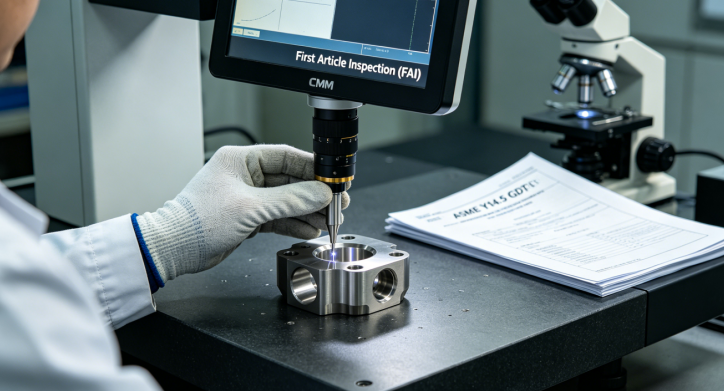
1. From Documentation to Active Prevention: SPC and Closed-Loop Control
In a mature Quality Management System, real-time process control takes precedence over just final inspections. It uses Statistical Process Control (SPC) during production, tracking critical aspects like cutting width and bend angles on the fly. These measurements show up on charts with control limits that sound alerts as soon as there’s any deviation. This lets operators make corrections right away. This closed-loop system is often required by higher standards such as IATF 16949, preventing whole batches from being ruined and fostering a true preventive quality culture.
2. The Rigor of First Article Inspection and End-to-End Traceability
The First Article Inspection, or FAI, sets the standard. It thoroughly checks every spec on the drawing and related docs, not just spot-checking but validating everything with production-level gear. Plus, for medical suppliers, a complete digital traceability system is crucial. This tracks parts from their final serial numbers all the way back to the exact raw materials, machine programs, operators, and inspection results used. This tracing system is key for analyzing issues and meeting regulations if anything goes wrong in the field.
3. A Culture of Quality and Continuous Improvement
The fanciest systems won’t cut it without the right company culture. So, check out the shop floor: look at organization, operator involvement in quality, and visible continuous improvement programs like Kaizen. Suppliers where teams are empowered and held accountable for quality at each step, backed up by integrated management systems, provide a reliability level way above those that only focus on audit docs. Going with a full-service sheet metal fabrication provider ensures you get this kind of thorough systemic support.
How Can Sustainable Manufacturing Practices, Like Material Optimization, Benefit Medical Device OEMs?
In the medical device sector, sustainable manufacturing is not only about being environmentally friendly, but also about enhancing design efficiency and resulting in more benefits over time. A sheet metal design that is less wasteful of material, for example, can conserve energy, simplify manufacturing and reduce expenditure. Such a move would also lead to the creation of lighter products that have less impact on environment besides, achieving business goals and demonstrating corporate responsibility.
- Topology Optimization and Nesting for Maximum Material Yield: With the help of state-of-the-art design software, topology optimizationis a possibility even these days. This leads not only to reducing the amount of metal used and cutting the weight of the product but also leaves the product resistant and strong. Also, sophisticated CAD/CAM nesting algorithms most of the time, hit a 90% yield, placing parts on sheets to make sure almost all the material gets used. So, this drastically reduces scrap which results in saving materials costs and lessening the trouble of waste disposal.
- Part Consolidation: Fewer Pieces, Higher Reliability: One of the simplest ways that assembly can be made easier is through the transformation of multiple welded or fastened components into a single smartly designed unibody part. This transformation is made possible by complex bending and forming methods. In this way, we eliminate welding steps, reduce assembly costs and time, and at the same time, get rid of weak points like seams and bolt holes. As a result, you get a product that is stronger, has a better appearance, and is more reliable.
- Eco-Conscious Processing and Regulatory Foresight: Sustainability includes our choices in finishing and processing too. Going with eco-friendly treatments, like trivalent chrome passivationover hexavalent chrome, cuts down on dangerous materials. Proper waste management for coolants, metals, and other leftovers isn’t just the right thing to do; it also helps us follow changing regional rules and EPA Guidelines. This keeps our supply chain safe from future regulation hassles and aligns with what healthcare providers and end-users value.
Conclusion
Original Equipment Manufacturers (OEMs) of medical devices should consider the manufacturability of their products at the design stage. Alongside this, collaborating with professionals who have a rigorous quality system and the necessary industry certifications, is crucial. Proactive DFM, material knowledge, advanced fabrication methods, and sustainability all help.These six strategies form a risk-reducing plan that protects project budgets and timelines while ensuring top performance. As a result, going from prototype to production becomes more predictable and controlled.
FAQs
Q1: What is the most common DFM mistake you see in sheet metal designs for medical devices?
A: Usually, the most common mistake is an incorrect bend radius specification for the thickness of the material, Mostly with medical-grade stainless steel. Using a bend radius that is too small can mean micro-cracks that could result in the weakening of the part and these cracks can also be corrosion or biofilm formation sites, which is a big concern for devices that are sterilized multiple times.
Q2: How critical is full material traceability for non-implantable medical device components?
A: It is very critical. Standards such as ISO 13485 require full traceability as a means to guarantee the consistency and to be able to present evidence during the regulatory audits. If the properties of the material from different and undocumented lots are changed, production can be inconsistent resulting in assembly problems which, even for Class I devices, can bring major risks in compliance and reliability.
Q3: Can rapid prototyping services really be used to validate a design that is aimed at high-volume medical productions?
A: In fact, they do different things. Rapid prototyping is initially for designing, for example, testing the shape and how well components fit together. Yet, production-intent prototyping should be same as production on materials and processes so that one can validate the manufacturing process, cycle time, and discover issues which are only noticeable at volume like springback and thermal distortion.
Q4: When do buyers go for medical suppliers that are ISO 9001 certified versus those that are ISO 13485 certified?
A: ISO 9001 refers to a general quality management standard while ISO 13485 covers In particular medical devices, including extra provisions for risk management, design controls, and meeting regulatory requirements. It reflects a thorough grasp of the particular necessities of the environment in which medical devices are manufactured. .
Q5: How does design optimization actually reduce the cost of a sheet metal part beyond just material saving?
A: By part consolidation, optimization like removes the need for welding/assembly steps, cuts the labor, and removes potential failure points. Besides that, it results in more consistent manufacturing tolerances, which increase the first-pass yield on the assembly line. The savings start with material, going through production, and ending with fewer quality management costs
Author Bio
The perspectives shared here come from a manufacturing expert who has more than 15 years of experience in developing fabrication solutions for regulated industries. LS Manufacturing, her organization, is certified by ISO 13485, IATF 16949, and AS9100D, and That means able to offer end-to-end manufacturing with a focus on quality and precision. If you would like a professional review of your medical device component design you can grab a free DFM checklist or submit your design for a feasibility study.